



Mark Damsgaard
Founder of Global Residence Index
Last updated: January 11, 2026

Mark Damsgaard
Founder of Global Residence Index
Last updated: January 11, 2026
The St. Kitts and Nevis citizenship by investment program has established one of the strictest nationality-based exclusion policies in the Caribbean. As of 2026, six nationalities face absolute ineligibility with zero exceptions or workarounds.
This represents a significant shift from the program’s earlier, more flexible approach. Understanding these restrictions matters whether you’re considering Caribbean citizenship options or advising clients on investment migration pathways.
The Citizenship by Investment Unit (CIU) currently prohibits applications from citizens of six countries. The official eligibility page frames this as necessary “for reasons of national security and public safety.”
The complete banned list includes:
This is not a restriction with conditional pathways. It’s an absolute bar to participation in the program.
The policy extends beyond citizenship status. Anyone “ordinarily resident” in these countries also faces exclusion under the 2023 regulations, regardless of what passport they carry.
Some online sources incorrectly reference seven banned nationalities. The controlling law and official CIU website both confirm six countries. This precision matters when evaluating eligibility.
The program didn’t always operate this way. Around 2015, St. Kitts treated certain high-risk nationalities as restricted rather than banned. Afghanistan, Iran, and North Korea appeared on watch lists, but permanent residents of Western countries could sometimes proceed.
Regional pressure intensified after 2018. The EU, UK, and US raised concerns about Caribbean citizenship programs potentially enabling sanctions evasion. Banking compliance issues made processing certain nationalities increasingly difficult.
By 2022, neighboring programs had already tightened controls. Dominica banned Russians and Belarusians. Saint Lucia suspended processing for Russia, Belarus, and temporarily Ukraine. The dominoes were falling across the region.
The turning point came in July 2023. St. Kitts issued the Saint Christopher and Nevis Citizenship by Investment (Exclusion) Order, SRO 27 of 2023. This legislative instrument formalized the six-country ban into statutory law.
What had been partly policy and partly practice became an unambiguous legal prohibition. The Order closed previous loopholes that allowed some applicants with Western permanent residence to apply despite holding restricted passports.
The list has remained stable through 2024 and into 2026. No countries have been added or removed. This consistency suggests the government views the current parameters as appropriately calibrated to balance security concerns with program accessibility.
SRO 27/2023 serves as the primary legal instrument. The CIU administers the policy under authority granted by this Order, which explicitly cites “national security, defense and public safety of the Federation” as justification.
The government doesn’t typically reference FATF or OECD guidance directly in public communications. But the connection is clear to anyone familiar with international compliance frameworks.
Enhanced due diligence requirements under FATF recommendations place special scrutiny on high-risk and sanctioned jurisdictions. Caribbean programs faced mounting pressure to demonstrate robust controls or risk their own visa-free access arrangements.
For Saint Kitts and Nevis citizenship by investment specifically, protecting visa-free travel to the Schengen Area, UK, and other partners represents an economic imperative. Losing those privileges would devastate the program’s core value proposition.
The banned nationality list functions as preventive risk management. It removes potential sanctions complications and due diligence bottlenecks before they create individual case problems.
Caribbean citizenship programs vary significantly in how they handle nationality-based restrictions. St. Kitts now occupies the strict end of the spectrum.
Antigua and Barbuda maintains no outright bans but restricts numerous nationalities. Applicants from Afghanistan, Iran, North Korea, Sudan, Yemen, and Somalia can proceed only if they’ve lived 10+ years in approved countries with no ties to their origin state.
Dominica fully bans Russia and Belarus, similar to St. Kitts. Other high-risk nationals face case-by-case assessment with stringent residence and no-ties requirements. The program exercises more discretion than St. Kitts’ bright-line approach.
Grenada relies on strict due diligence without formal banned lists. Approvals for sanctioned or very high-risk nationals remain theoretically possible but practically rare given enhanced scrutiny.
Saint Lucia doesn’t process Russia, Belarus, and had temporarily suspended Ukraine. Banking constraints and due diligence feasibility often drive these decisions as much as political considerations.
St. Kitts stands out by combining a short list with absolute prohibition. Six countries may seem limited compared to programs with longer restricted lists, but the zero-exception policy makes it functionally more restrictive.
For citizens of the six banned countries, all paths to St. Kitts citizenship close. The donation route is unavailable. The real estate route is unavailable. No alternative investment option creates an exception.
Dual citizenship doesn’t solve the problem. While the official text speaks of “citizens of” the banned countries, industry practice treats anyone holding one of these passports as ineligible. The risk management perspective prevails over literal statutory interpretation.
Long-term residence elsewhere doesn’t help either. Unlike Antigua’s framework that accepts certain restricted nationals who’ve migrated young and established decade-plus ties to approved countries, St. Kitts offers no such pathway.
The “ordinarily resident” language in SRO 27/2023 extends the exclusion to non-citizens living in banned countries. Someone from a neutral nationality who happens to reside in Russia or Iran would face exclusion on that basis alone.
Banking and payment processing create additional complications. Even if policy exceptions existed, financial institutions increasingly refuse to handle transactions involving these jurisdictions. The practical infrastructure for processing applications has eroded.
St. Kitts positions itself as the “platinum standard” in citizenship by investment. This branding requires demonstrable commitment to compliance that exceeds peer programs.
The due diligence framework operates on multiple tiers. Internal CIU vetting combines with independent international background investigations. Checks run in both home countries and current residence jurisdictions.
Security screening systematically queries sanctions lists, watchlists, INTERPOL databases, and adverse media sources. Large specialized firms like Exiger conduct enhanced investigations for the Caribbean programs.
From 2023 onward, the government has moved toward biometric data collection and discussed possible residency or interview requirements. These would add human touchpoints to what has historically been a largely document-based process.
The banned nationality list functions as a first-filter tool within this broader architecture. It removes applicants who would face extremely high scrutiny and likely struggle to pass banking and source-of-funds verification.
Options exist, though they’ve narrowed considerably for some groups. Russians and Belarusians face the tightest constraints following 2022 developments across multiple programs.
Antigua and Barbuda may accept certain high-risk nationals if they migrated before majority, hold 10+ years residence in approved countries (US, UK, Canada, UAE, etc.), and maintain no ties to their origin state. The bar is high but some applicants clear it.
Dominica and Saint Lucia treat Russians and Belarusians more restrictively. Some other banned-list nationals might receive case-by-case consideration under strict conditions. Each situation requires individual assessment.
Grenada’s lack of formal banned lists creates theoretical possibility. Practical approval for sanctioned or very high-risk nationals remains rare given intensive due diligence and banking challenges.
Residency by investment programs offer alternative pathways. Golden visa schemes in various jurisdictions focus more on current residence, income, and clean records than nationality origin, though sanctions compliance still applies.
EU programs, Gulf residency options, and certain Asian or Latin American schemes may prove accessible where Caribbean citizenship is not. Vancis Capital, the parent company of Global Residence Index, maintains expertise across these alternative pathways and can guide clients toward viable options.
Citizenship through ancestry deserves consideration. EU states, Latin American countries, and others offer descent-based citizenship that doesn’t involve investment or discrimination by nationality of birth.
Ordinary naturalization after residence in a third country creates another path. This requires time and usually physical presence, but ultimately delivers citizenship through traditional channels that assess individuals rather than national origin.
The banned list has remained stable since mid-2023. No evidence suggests imminent additions or removals as the program enters 2026.
Regional coordination among Caribbean programs continues. Minimum common standards discussions with EU and US partners may drive convergence toward similar nationality policies across competing jurisdictions.
Geopolitical developments could trigger future expansions. Sanctions environments change. Political risk profiles evolve. The framework exists for the government to add countries if circumstances warrant.
Conversely, thawing relations or changed compliance landscapes could theoretically enable removal of countries from the list. Russia and Belarus seem unlikely candidates for near-term rehabilitation given current international dynamics.
The program’s emphasis on protecting visa-free access suggests the banned list will expand before it contracts. Maintaining Schengen, UK, and other travel privileges takes precedence over maximizing applicant volume from all sources.
Navigating citizenship by investment with nationality-based restrictions requires specialized knowledge. The regulatory landscape shifts. Program rules evolve. What worked last year may not work today.
Global Residence Index maintains direct relationships with government bodies and regulatory agencies across Caribbean programs. This expertise helps clients understand real-time eligibility and identify genuine pathways rather than pursue dead ends.
For applicants from the six banned nationalities, honest assessment matters more than false hope. A reputable advisor will acknowledge when St. Kitts is genuinely closed and redirect attention toward viable alternatives rather than suggesting workarounds that don’t exist.
The firm has guided over 500 clients through investment migration processes with a 100% approval rate because pre-screening eliminates applications that wouldn’t succeed. This approach protects both client investment and program integrity.
Each situation is unique. While national origin creates bright-line rules in St. Kitts, other programs exercise more discretion. Professional guidance helps match individual circumstances to the programs most likely to deliver successful outcomes.

Let us help you
As a trusted golden visa & citizenship by investment agent, our team is equipped to assess the ideal options for your unique situation, facilitate your application process, and keep you in compliance every step of the way. Our personalized investment migration consulting is your one-stop shop for obtaining a second citizenship or new residency. Fill out our contact form to get started with a complimentary consultation today.
GET PERSONALIZED GUIDANCE
What to expect during your consultation?
We proudly offer free consultations to interested applicants.
Here is what you can expect from your free consultation with our advisory team:
By the end of the consultation, you will know if you’re eligible to apply so you don't spend time and money investigating yourself
We will answer any specific questions you have about the program and application process
Our advisory team will explain every step of the process in detail so you know what to expect
We’ll help you understand the best programs and options for your situation
Contact Us
We value your privacy. Any details you share will be handled with complete confidentiality. Fill out the form below to connect with our team of experts. We look forward to assisting you.

We look forward to assisting you.
We offer clarity and reliable advice across a wide range of investment opportunities and immigration programs. We provide complete, personalized support - from the moment you reach out to the day your new residency card or passport is in your hands.

Our global team of experts is ready to help you.
Get a step-by-step guide
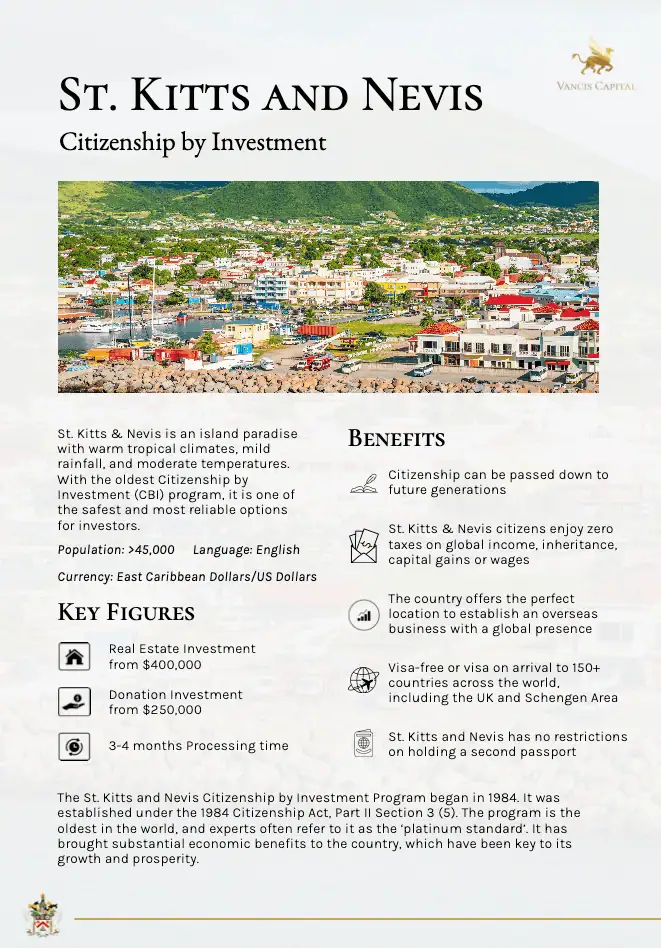
to applying for Saint Kitts & Nevis Citizenship
We will help you apply with confidence, relying on our expertise and up-to-date market analytics.
Get a step-by-step guide
to applying for an Italian Golden Visa
We will help you invest with confidence, relying on our legal experience and up-to-date market analytics.